
RSS Feed
Singing the Praises of Accel Wipes
Sep 20 2011
People ask me all the time what I carry in my doula bag. I usually list off the typical stuff - massage oil, rebozo, LED tealights, etc. However, one of my favourite and most-used items is my Accel TB wipes (I always carry a little pouch of 10). Here's why:
- It's accelerated hydrogen peroxide, so it's great at removing blood stains. Just wipe the carpet or couch, and voila! (individual results may vary, but I have had incredible success).
- I can wipe down my TENS machine, reflexology ball, or anything else that might have bodily fluids (including sweat) on it. I can quickly make sure everything is clean BEFORE it goes into my doula bag, and then I know it's ready to go for the next birth.
- It's gentle enough to wipe down a birth pool without corroding the material. In fact, it's so gentle that the MSDS sheet states it doesn't even require gloves to be worn. It's incredibly convenient and quick to disinfect the birth pool. After I drain the pool and take off the liner I wipe the pool down, I let it sit for 20 min or so, and then pack it up so it's ready to go for next time. No need to re-inflate it at home in between births!
- It doesn't have a noxious fume to it, so you can use it right there at the birth place without it bothering anyone (including yourself).
- Because it's medical grade, I can use it to wipe the faces of my baby dolls before an infant CPR class. This is especially wonderful when I am teaching more than one class in a day, and therefore can't go home and bleach everything.
- The little 10 pack is no larger than a packet of facial tissue, so I don't have to make much room for it in a full bag.
So there you have it - a doula and midwife bag essential!
Bag Reviews
Jun 12 2011
This past Wednesday I had three newly graduated midwives come over and give their opinion on some of my new Ferno bags. It was so helpful to me to see the bags filled, and get some professional input!
Bag #1 - Green Rucksack
Here is the bag filled with Amy's equipment (everything except her oxygen).

The entire inside of both sides of the rucksack is velcro, and it comes with a bunch of colour-coded clear mini bags that can be arranged any way you want with the velcro. It's great for compartmentalizing all the gear. For example, you have all your meds in one bag, all your IV stuff in one bag, all your intubation equipment in another, etc. Because they're colour coded, in an emergency you can yell to someone "get the red one!". Amy thought the colour coding was a great feature. While it did not have room for an oxygen tank, it did have room for everything else, with quite a bit of space to spare. You can see that her doppler, suction unit, resuscitator, and everything else are highly visible and fit with ease.

This picture shows the front pocket on the rucksack. It's quite ample. Here it contains an IV kit and an intubation kit that are both packed full.

Here's Amy wearing the rucksack (though we didn't really make an effort to fit it to her properly). She found the weight to be very manageable. The straps on this one are not as comfortable as a couple of the other backpack models we tested. It would be great for just taking it from the car to the house. It would not be comfortable to trek with. Amy appreciated the versatility of this bag, however a midwife would also require a second bag with her oxygen equipment if this was her bag of choice.
Bag #2 - Ferno Airway Management/Oxygen Bag
This was Amy and Rachel's pick!

Here is the bag opened to the main compartment. This bag came with 3 different sized see-through bags that were detachable with velcro for compartmentalizing equipment. Amy also liked that she could fit her oxygen in here. This bag came with a blue fabric casing for an oxygen tank, and it also had a durable handle on it. You can't see Amy's tank because it is a C- tank and it's fully enveloped in the blue fabric. A D-tank would stick out a bit (the bag is designed for a D or jumbo D, so a C fits really easily). Amy was able to fit all of her equipment in here, so a second bag would not be necessary. It's also well padded, making oxygen transport safer.

This picture shows how there is a flap on the front of the bag that opens up so that you can access the oxygen without taking it out of the bag. You had to dig a bit with the C tank, but with a D tank the regulator would be right at the top there for easy access. There is also a little pouch on the inside of the flap for airways or oxygen masks.

Here Amy shows the backpack straps. This backpack has well-built, padded straps, as well as a sternum strap. You could actually trek with this on!

Bag #3- Ferno Trauma/Airway Management Bag II
The perk about this bag was the flip top that allowed for very quick and easy access to the O2 without taking it out of the bag.

The bag also had lots of little compartments that you could change around with velcro, and was also a well designed backpack.


(As you can see, at this point my 2 year old came home from the park, so that was the end of our morning bag testing session with Amy).
Bag #4 - Ferno Saver Duffel O2 Kit
This bag was quite long and skinny. I was well padded, and had a buckle for safe oxygen transport.

Here you see the long, versatile pockets.
On one end there is an ample end pocket. On the other side there is a wide elastic strap.

Bag #5 - Ferno Saver ALS Bag
This coupled with an oxygen carry bag was Jasmine's pick. Between the two bags it contained all of her equipment, including a De Vilbiss suction (the larger one).

This bag was not as compartmentalized as some of the more expensive Ferno bags, and it does not convert into a backpack. It also is a bit smaller in size. However, Jasmine found it to be a perfect match for the amount of equipment she carried.

Our Economical Classics -
The benefit of the high end Ferno bags is that they are made with top quality material and have lifetime warranties. Their Saver liner is also good quality, but doesn't carry the same warranty. Also, unlike the top-quality bags, you can't unzip the padding for proper cleaning.
But what if you're not looking to spend $100-$300 on a bag? We have some other great options for you as well!

These bags can be purchased separately or as a set. They all come in red and blue, however, not all bags are always in stock in both colours.

Our prenatal bag is affordable and versatile. The inside dividers can be removed or rearranged with velcro, and more items can be zippered into the inner lid.

The "Midwife" duffel bag is a run-of-the-mill duffel bag with extra inner pockets in the front for organizing little things, as shown. It's well constructed, and has ample end pockets.
Our entire new registrant kit fits into the duffel bag and the oxygen carry bag. This includes a De Vilbiss suction, but it can be a bit tight. With a Laerdal suction there would be plenty of space.

Mini Bags-
Ferno IV Bag

This handy little organizer is great for storing your IV supplies.

This kit contains an entire antibiotics IV kit (except the 1000mL fluid), as well as some extra butterfly needles and a saline lock.
I also used the Ferno Intubation Bag for the same purpose, shown below:

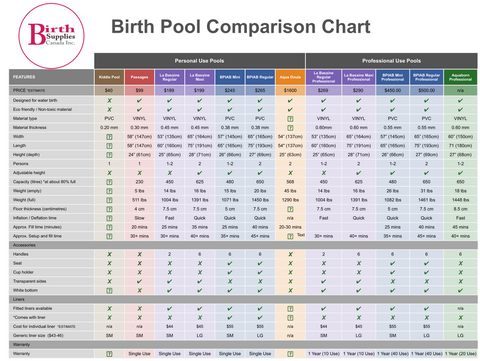
Choosing a Birth Pool
Apr 21 2011
Whether you're actually planning to give birth at home in the water or
just want to labour in the water a bit, birth pools can offer some
incredible pain relief. There are several choices on the market. Here is
a guide to help you decide which one to get. (Please note that all
prices are Canadian).
The Aquarium Pool

This is the cheapest way to go. One of these will set you back about $30.00 from most big box stores.
Pros:
-Cheap.
-Holds less water, so less taxing on the hot water tank.
Cons:
-Many women find them too shallow. Deeper pools allow for more buoyancy, and this allows for greater pain relief.
-They are not phthalate or cadmium free. Keep in mind, you are
filling this pool with hot water. When the plastic is heated it can
leech these chemicals which have been shown to be unhealthy.
-Some of these pools have drain plugs on the bottom. This is a good
feature if you're playing in the back yard. It's a really bad feature if
the pool is set up in your living room and you accidentally kick the
plug open in labour.
-The quality of material on these is variable. They also do not come
with liners, which can act as an extra barrier against leaks and
prevent punctures while in use.
-These can be difficult to find in the winter, as they are a seasonal product.
La Bassine (Made in Water) Birth Pool $195

Pros:
-Designed for birth and use inside the home
-2 handles on the inside of the pool for extra support
-Holds less water than other birth pools, so less taxing on a hot water tank, and faster fill time.
-Takes up less space than a larger birth pool
Cons:
-Darker blue colour (or purple for the pro model) do not allow for the same visibility as a white bottomed pool
-Not height adjustable
-Some taller women may not get full immersion of their belly (or
will have to fill it too full to do so and risk water tipping over the
edge).
-Depending on size, sometime there is not enough room for the partner to get in.
-No top or outside handles
-No lid option available for keeping the heat in
-Liners are sold separately (it's worth the extra $$ to buy a liner though. That's another blog post in and of itself).
The Aquaborn Eco Birth Pool - $199

Okay, I'll admit, I'm not completely impartial. Even though I sell
all three birth pools, I am the Canadian distributor for Aquaborn.
However, I wouldn't be the distributor if I didn't think these pools
were the Bees Knees. I also definitely plan to give birth to my next child in one of these.
Pros:
-Green colour with a white bottom allows for maximum visibility (actually I find the difference quite remarkable).
-Height adjustable
-Designed so the midwife/support people will not strain their backs
-Comes with a lid and liner included
-Thickest padded floor
-6 handles for maximum versatility
-Opaque sides allow for privacy
-Large enough to accommodate both partners with room to move
-The deepest birth pool on the market
-The thickest eco-vinyl available for durability (all birth pools and their liners are phthalate and cadmium free).
Cons:
-Larger, deeper pool, so may be taxing on a small hot water tank and take a bit longer to fill
-No seat (though submersible spa seats can be bought separately for about $25 if this is important).
Birth Pool in a Box -$295 + $65 for lid

Pros:
-Egg shape make some women feel more cocooned.
-Has a seat (regular model only)
-Mini option available for smaller spaces/hot water tanks (but these have no seat)
-Comes with a liner included
-White bottom
-Height adjustable
-Regular model is large enough for both partners
Cons:
-More expensive
-Regular model has larger water volume, so takes longer to fill and drain than La Bassine and Aquaborn
-Lid is sold separately.
Aqua Doula - Usually available just for rental. A purchase would set you back about $1200.00
I rented one of these for the birth of my daughter.

Pros:
-Heater. You should NEVER use a heater with an inflatable pool, so if you really want a heater, this is the way to go.
-Very sturdy and large, allowing for good movement and buoyancy.
-A rental usually will come with a lid and all the accessories.
Cons:
-Not as cushy as inflatables. Many women prefer inflatables for the comfort factor.
-Much harder to set up and take down, particularly if you have never done it before.
-No handles
-Can be taxing on smaller hot water tanks
The Inflatable Birth Pool Comparison Chart
@font-face {
font-family: "Cambria";
}p.MsoNormal, li.MsoNormal, div.MsoNormal { margin: 0cm 0cm 10pt; font-size: 12pt; font-family: "Times New Roman"; }div.Section1 { page: Section1; }
|
Pool
|
Birth Pool in a Box Regular - $295
|
La Bassine - $195
|
Aquaborn Regular $199.99
|
|
Material Thickness
|
0.38mm
|
0.42mm
|
0.45mm
|
|
Internal maximum dimensions
|
142cm x 114cm
|
125 cm x 95cm
|
130 x 105 cm
|
|
Internal Depth
|
66cm
|
66cm
|
68cm
|
|
Internal Handles
|
No
|
Yes
|
Yes
|
|
Side Handles
|
No
|
No
|
Yes
|
|
Top Handles
|
Yes
|
No
|
Yes
|
|
Inflated Floor Thickness
|
5cm
|
7.5cm
|
8.5cm
|
|
Seat
|
Yes (Regular size only)
|
No
|
No
|
|
Liner included
|
Yes
|
Yes
|
Yes
|
|
Filling Time
|
40+ minutes
|
25 minutes
|
35+ minutes
|
|
Weight when filled
|
650 kg
|
520 kg
|
560 kg
|
|
Heat Retaining Lid
|
Extra- $65
|
No
|
Included
|
|
White Bottom (best visibility)
|
Yes
|
No
|
Yes
|
|
Professional Option Available
|
Yes - $500
1 liner incl.
|
Yes - $280
no liner incl.
|
Yes - $410.00
3 liners incl.
|
Perineal Healing Tips
Apr 21 2011
I don't know about you, but I needed a few stitches when my daughter was born (she decided to shoot out like Superwoman with one fist charging our straight in front of her head). Perineal healing herbs were an invaluable asset to have handy. When you're sore like that, you want to have some arrows in your quiver.

Here are some ideas for using our Perineal Healing Herbs:
NOTE: These herbs are not to be taken internally - It is for topical use only.
Brew a tea (for a sitz bath, not to drink!)
Begin by making a strong infusion of your herbs:
Bring two cups of water to a boil then remove from heat. Pour the water over two heaping
teaspoons of herbs and cover. A wide mouth jar or teapot is useful. Allow the mixture to
steep for at least half an hour (overnight is best) then strain well. Keep any unused mixture
in the refrigerator for up to three days.
Sitz Bath
A sitz bath is a basin that fits over a toilet, allowing you to soak your perineal area without
having to take a full bath each time.
Fill your sitz bath with two cups of your brewed herbal tea and 6 to 10 cups of warm water. You
may use cold water if there is inflammation or swelling. Sit and soak for 10-20 minutes, 1-3
times daily (can alternate between a sitz bath and a bath). You may also add in 1/4-1/3 cup
Epsom Salts.
Regular Bath
Add the full two cups of Perineal wash tea to your bath water, or try our Perineal Wash
Bath Bags, which you can simply toss in your bath and steep. You may choose to add 1
cup of Epsom Salts.
Peri-Bottle
A favorite! Peri Bottles are plastic squirt bottles that allow you to squirt water out as you go
to the bathroom or for cleaning (instead of wiping -especially if you are still feeling sore or
sensitive) when you are finished. It can greatly reduce stinging during urination. The tea
may be used undiluted or add some hot water to make it warm. It is handy to have a bottle
ready in your bathroom at all times. The bottle is also useful for people with hemorrhoids
and during menstruation - just add water or other useful herbs for the different situations.
Compress
Soak a washcloth in the cooled mixture and apply to the sore area. You may soak a
maternity pad and wear it for continuous healing. Many women find great relief when the
soaked pads have been cooled in the refrigerator. You may wear an additional dry pad or
folded blue underpad inside disposable mesh panties to keep your seats dry.
When Faith and Science Mingle and Conceive
Mar 16 2010
[Creighton Model is a method of charting a woman’s fertility and helping her to understand the natural processes of her own body. NaPro technology is a medical regimen that treats a whole host of gynecological issues without obstructing or suppressing any reproductive functions.]

Despite what I often see portrayed in the media around me, I firmly believe that faith and science are not mortal enemies. In fact, there are times when religious doctrine necessitates innovation, and amazing discoveries are made as a result.
The Creighton Model fertility care system and NaPro are two such examples.
In the Catholic Church, as well as many other world religions, the use of any artificial birth control or purposeful fertility obstruction is expressly forbidden. So what is a pious Catholic woman to do if she suffers from raging hormonal imbalances, severe endometriosis, out of control PMS, or reoccurring ovarian cysts? What if her health or socioeconomic situation dictate that she should not conceive a child at this time, but she still desires a sexual relationship with her husband? The rest of the world solved these problems with hormonal birth control. Out of this dilemma, a pious Catholic doctor responded, and Creighton Model was born.
While this system was created by a Catholic to meet the needs of Catholic women and families, the knowledge learned can help a whole generation of women regardless of religion, creed, or point of view.
Creighton Model is more than keeping a chart. It is a way for women to learn to trust their bodies, understand their reproductive cycles, and receive natural, hormone balancing treatment for any abnormalities that occur.
We live in a society that loves to solve every problem with a pill. The problem with this is that pills usually treat only the symptoms of a problem, and don’t get to the root of it. If a woman suffers from heavy periods, severe cramping, irregular cycles, excessive body hair, or other hormonally driven problems, the most common solution offered by doctors is a birth control pill. While on the pill, women typically have regular 28 day cycles, bleed less during menstruation, and often any external issues also lessen or disappear. However, they have not been cured, and if they choose to go off the pill, these problems often simply return. So these women are left with two choices: stay on the pill, or suffer.
But what if a woman wants to conceive? Obviously she would need to stop taking her birth control. What if the problems return? What if her hormones return to their imbalanced state and conception is unlikely or impossible? This is where pharmacology alone fails us.
When a woman charts her fertility through Creighton Model, and regularly reviews her chart with her practitioner, many problems can either be caught early, or treated quickly and simply. I have personal experience with this.
I had no idea that there was anything abnormal about my cycles other than their length. They were incredibly variable. Sometimes they were 30 days long. Sometimes they were 70 days long. It had always been that way since I began menstruating, so I never thought twice about it. When I began charting with Creighton, my practitioner quickly saw that I had abnormal spotting, prolonged bleeds, as well as other abnormalities in my cycles. My husband and I were not trying to conceive at the time, so I had really not considered any issues with future fertility. My practitioner referred me to a Creighton trained physician in my area, and through blood tests and ultrasounds, I was diagnosed with PCOS (polycystic ovarian syndrome). I had no outward physical symptoms of it, but my cycle showed it clearly. If I had been on birth control, I would never have known.
This diagnosis can be devastating for a family trying to conceive. Many women with PCOS struggle for long periods of time, and often go through many different therapies to try and ensure ovulation, conception, and retention of a pregnancy. This is where NaPro came in. NaPro protocols simply work to balance the hormones to bring back (or create for the first time) normal reproductive function. While I can never know definitively, I have a feeling that our ease in conceiving our daughter is due to this therapy regimen.
However, the greatest benefit that I have taken from fertility awareness is the power and knowledge I have acquired about my own body. I don’t have to rely on a regular 28 day cycle to know when I will menstruate or when I am optimally fertile. I can listen to and work with my own body to plan my family and be responsible for my own reproductive health. It puts the power back into my hands, and out of the pockets of drug manufacturers and doctors. It costs me nothing per month, and there are no negative side effects or drug interactions. It will last me my entire reproductive life. When I choose to become pregnant again, I will be able to know my due date without the help of an ultrasound, regardless of the length of my cycles.
So, when it comes to reproductive science: religion does not necessitate ignorance, and knowledge is power. Let’s give that power back to women.
For more info:
http://www.creightonmodel.com
http://www.naprotechnology.com
A More Accurate Nativity Scene
Dec 16 2009

I like this painting. It reminds me of a rather typical home birth scenario: we have the mother, no doubt exhausted, resting on a crimson mat (these were the days before blue chux pads, after all), while the midwife examines the new born, and her maidservant (literally her doula) cleans up, and draws water for either cleaning up the mother, or bathing the newborn, or something of that nature. The father looks on, perhaps in shock, disbelief, or awe at the miracle that has just taken place.
While the canonized Bible is silent about the exact details regarding the birth of Jesus, there are early Christian writings and lore that speak of two women (sometimes referred to by the names Salome and Sarah) being the first people (other than Mary) to witness the infant Jesus. This tradition was carried up through both the Western and Eastern Churches, as there are pieces like this painted by both Orthodox and Italian artists, even into the early Renaissance period. This painting is very accurate, when put in the cultural context of the birth of Jesus.
Birth was an event that was restricted to women. Unlike many modern renditions of the Nativity, Joseph would not have delivered Jesus, and was most likely not even present to witness it. Mary is cleaned up and resting, while the women attend to the details of the birth process. Joseph keeps to the side, and likely just entered the room. He would not have been present for the delivery of the afterbirth, and would have waited outside until his betrothed was all tidied up. According to Hebrew tradition, Mary would have been regarded as unclean, due to the fact that she was bleeding. Joseph was forbidden to even touch her.
Whether Mary laboured in the presence of a midwife, or whether the midwife arrived just moments too late, is a debated issue among scholars of early Christian writings. One can only imagine the strength that Mary had as young teen to be labouring unsupported as Joseph frantically sought out a midwife at night in a city that was not their home – this after enduring a donkey ride of several days to travel there. The face of a wise woman would have been very comforting as she groaned and swayed through her labour. I’m sure that the presence of other women either at or immediately after the birth, would have been much more valuable to Mary than any amount of gold, frankincense, or myrrh.
So forget the shepherds. Forget the Magi. It was the birth attendants who were so blessed as to be the first witnesses to the life of Jesus. It really is a story of redemption, as women would have fallen even farther down than shepherds on the social scale. However, women were given the honour that night – not for their wealth or social standing – but for their strong hands, their strong presence, and their strong faith in the ability of a teenage girl to give birth. This is what I will remember every time I drive past a Nativity display.
So whether you observe the holidays by gazing at a tree, a log, a menorah, a wreath, the fireplace channel, or a suckling newborn, may you find joy and peace (salome) this holiday season.
Waterbirth - for the spirit
Sep 20 2009

Giving birth in water just makes sense to me.
I did my BA in religious studies, and over and over again I saw water as a reoccurring theme in religions and cultures throughout the world. For the Ancients, water was often viewed as a symbol of both chaos and fertility. Christians are not the only group that uses baptism as a rite of rebirth and cleansing. Many Jewish groups baptize as a rite of conversion and purification. Hindus find spiritual significance in bathing in the sacred Ganges. In Islam, washing is deemed necessary before entering a Holy site, and special fountains are usually situated in front of the entrance for that purpose. Nobility practiced water birth in ancient Egypt, and it was thought that a baby born in water would one day become a priest or priestess.
So how does this relate to birth in our time and context? Well, first of all, whether a person is “religious” or not, the birth of a child is a significantly spiritual event in a family. Even if people don’t realize it, becoming a parent changes a person on a spiritual level. It changes the way they think, live their lives, and view the world. Children instill a sense of meaning and purpose in our lives, and give us a vested interest in the future. Childbearing and parenthood teaches people about love, giving, and sacrifice. Is this starting to sound familiar?
It makes sense then that water be used either symbolically or physically as a vessel for childbirth. My daughter was born in the water right on the cusp of the Greek zodiac signs Aquarius and Pisces – a true water baby. While I am not a follower of astrology, I can’t help but believe that she was holding out for that birthday. She was 9 days overdue, and I had been begging and pleading with her to be born for quite some time. Perhaps that day meant something to her, or just to me. I suppose I will never really know. What I do know is on that day I was reborn as a woman. I would never be the same. In my arms I held a new life – a spotless, clean slate of possibility and limitless potential. I had entered the waters of chaos, and emerged from my pool a new person – a mother (and a whole different kind of chaos)!

A Short Introduction
Jun 22 2009

My name is Jill Colpitts, and along with the support and assistance of my husband Paul, I am the new owner of Midwifery Supplies Canada.
I have a passion for birth and midwives. It’s in my core. It’s part of who I am. However, if you had met me five years ago, it was the farthest thing from my mind.
I had mentored a teenage girl for several years before she moved to Ontario. I missed her terribly, and when I heard that she was pregnant I wanted to be there to support her. I knew nothing about birth, or what to expect in the delivery room, but I knew I wanted to be there for her. The day her son was born, my life changed forever. I was hooked.
A couple of weeks later, I was teaching CPR to a couple of midwifery students. They explained to me what a doula was, and how to go about becoming one. The idea sounded intriguing, and within the next year, I became a DONA certified birth doula, and a postpartum doula as well. I earned much of my doula experience supporting young moms through a local youth pregnancy program. I also had opportunities to see the different models of care that were offered by obstetricians, GP’s and midwives. I developed a deep respect for midwives, and the incredible support they offered birthing women. I was so encouraged when I saw the effort they put into honouring a mother’s wishes for natural birth, even in the hospital setting. I knew this was what I wanted for my own birth.
Earlier this year, I gave birth to my daughter, Annika. She entered the world peacefully through the water of a birthing pool in the attendance of two midwives and my doula (in addition to Paul of course). It was the fiercest and most amazing day of my life so far. My midwife offered me wonderful care, and through the long night before, she had reminded me how normal birth was. I felt loved and supported by everyone on my support team that day, and it made all the difference in the world.
Because of my incredibly positive experiences with midwives, I am so thrilled to own this business! I look forward to serving midwives and other birthing professionals so that they can better support and educate birthing families in their community.
I strongly encourage you to email me with any feedback you have about the business, as I’m just starting to get it all together. If there are any products you would like me to carry, let me know. I am always looking for new ways to expand and reach out to the birthing community throughout Canada and beyond.
New Owners Announcment!
May 29 2009
It is with great excitement that I announce the new owners of this shop!
Jill and Paul Colpitts, also the owners of www.safebeginnings.ca

Aboriginal Midwifery in Canada
Aug 08 2008

Since the mid-1980s, there has been a movement to bring birth back to Aboriginal communities, through the training of local midwives, the establishment of birthing centres and the integration of traditional and western practices. This mobilization has developed in response to government policies that have required Aboriginal women to give birth in southern and urban centres for decades, rather than in their own homes and communities.
In this 20 minute documentary, First Nations, Inuit and Métis midwives and representatives from Aboriginal organizations discuss the challenges, benefits and significance of Aboriginal women taking control of this most sacred ceremony and bringing it back home.
To hear the Pod cast visit the NAHO/The National Aboriginal Health Organization.
Ancient Egyptian Midwifery and Childbirth
Jun 03 2008
In ancient Egypt there were no known words for midwife, obstetrician, or gynecologist. But because ancient Egyptians did not have words for these things does not mean that they did not exist. In Ancient Egypt the midwife came in many forms. For peasants the midwife was a friend, neighbor, and/or family member who helped deliver the baby. For noblewomen and wealthier classes the midwife was usually a maidservant or nurse who already lived in the household. Midwives at this time did not have formal training to learn their trade. Instead they learned by apprenticeships where the knowledge was passed down from family member to family member or from friend to friend. The work of the midwife included providing emotional support, encouragement, medical care, and religious help and protection to women during their lives. The areas that midwives focused on were pregnancy, labor, fertility, and contraception.

Most ancient Egyptian women labored and delivered their babies on the �cool roof of the house or in an arbor or confinement pavilion, which was a structure of papyrus-stalk columns decorated with vines� (Parsons p. 2). In Ptolemaic times, women from the noble class gave birth in birth houses that were attached to temples. The positions that these women took when they delivered their babies were standing, kneeling, squatting, or sitting on their heels on birthing bricks, or sitting on a birthing chair. The midwife would then be positioned in front of the mother to help the delivery and catch the baby. Two other women or midwives would be placed on either side of the mother to hold her hands and arms while she was pushing and to give encouragement. Sometimes the midwife would place a dish of hot water under the birthing chair so that steam could help ease delivery. The birthing bricks that ancient Egyptian women used were 14 by 7 inches long and decorated with colorful painted scenes and figures of the birth process. Birthing chairs were made of brick and had a hole in the center. They were decorated with hieroglyphic inscriptions of the owner and painted scenes of the mother, baby, and goddesses.
Since birth and delivery could be dangerous for both the mother and child, ancient Egyptian midwives used many goddesses and gods for help and protection. Goddesses and gods which ancient Egyptian midwives and women thought would help during pregnancy and birth were Hathor, Bes, Taweret, Meskhenet, Khnum, Thoth, and Amun. Hathor was the guardian-goddess of women and domestic bliss and watched over women giving birth. She took the shape of a cow. Bes was a dwarf-goddess who vanquished any evil things hovering around the mother and baby. Taweret was the pregnant hippopotamus-goddess and the chief deity of women during pregnancy, childbirth, and breastfeeding. She carried a magic knife or the knot of Isis. Meskhenet was depicted in the shape of a birthing brick with a human head and gave strength and support to the laboring mother. Khnum was the creator-god who gave health to newborn babies after birth. The god Thoth helped the delivery along and the god Amun helped sooth severe labor pains by blowing in a cool northern breeze (Parsons, p. 3). Statues and pictures of these goddesses and gods were placed throughout room and painted on the walls, birthing bricks and chairs that the laboring women used. Another way that midwives called on divine help and protection during labor was to �place a magic ivory crescent-shaped wand, decorated with carvings of deities, snakes, lions, and crocodiles, on the stomach of the women giving birth� (Parsons, p. 3).
On the Ebers, Kahun, Berlin, and Carlsberg papyri there are many tests and methods described for fertility, pregnancy, and contraception that ancient Egyptian midwives and women used.
Birth Control:
-Silphium, honey, and natron used for their contraceptive properties.
-Soak cotton in a paste of dates and acacia bark and insert into vagina.
-Acacia, carob, dates, all to be ground with honey and placed in the vagina.
Fertility Treatment:
-A woman should squat over a hot mixture of frankincense, oil, dates, and beer and allow the vapors to enter her.
Pregnancy Tests:
-Emmer and barley seeds, the lady should moisten with her urine every day, like dates, and like sand in two bags. If they all grow, she will bear a child. If the barley grows it will be a male, if the emmer grows it will be a female, if neither grow she will not bear a child.
-Examine the blood vessels over the breasts. Smear the breasts, arms, and shoulders with new oil. Early in the morning if her blood vessels look fresh and good, bearing children will occur. If the vessels are green and dark, she will bear children late.
-Give a women milk from one who had already borne a male child mixed with melon puree. If it made the women sick she was pregnant.
Induce Delivery:
-Place on the woman’s abdomen a plaster of sea salt, emmer wheat, and rushes from the Nile River.
Contracting the Uterus:
-Mix the kheper-wer plant, honey, water of carob, and milk. Strain and place in the vagina.
Spells to Assist the Birth Process:
Come down, placenta, come down! I am Horus who conjures in order that she who is giving birth becomes better than she was, as if she was already delivered…Look, Hathor will lay her hand on her with an amulet of health! I am Horus who saves her!� Repeat four times over a Bes-amulet, placed on the brow of the woman in labor.
Make the heart of the deliverer strong, and keep alive the one that is coming.�
References:
Permission for the re-printing of this article came from Emily Hildebrant, EMuseum Manager.
Thank you Emily!
Archaeologists uncover 3700-year-old `magical’ birth brick in Egypt. Eurekalert http://www.eurekalert.org/pub_releases/2002-07/uop-au3072502.php 30 Nov. 2002.
Parsons, Marie. �Childbirth and Children in Ancient Egypt. Tour Egypt http://www.touregypt.net/featurestories/mothers.htm 30 Nov. 2002.
Ancient childbirth seat found in Egypt. Blueyonder http://www.ancienthistory.pwp.blueyonder.co.uk/enter/news/272.htmlhttp 04 Nov. 2002.
Women’s Health and Obstetrics in Ancient Egypt.
Geocities http://www.geocities.com/honda841/Egypt.html 04 Nov. 2002.
Health�Egyptian Approach to Illness, Pregnancy and Childbirth. Members http://members.rogers.com/jasthompson/healthinegypt.htm 04 Nov. 2002.
Ancient Egypt: Medicine-Pregnancy and childbirth. Reshafim http://www.reshafim.org.il/ad.egypt/timelines.topics/medicine.htm
Written by Alison Thiele, 2002
Pinard Making
Apr 06 2008
Well we did it!
We have been officially up and running since January and are happy to be here and running the midwifery shop and birth shop together all at once!
I really do love the traditional aspect of midwifery, so it just feels right to have someone I know making some of the products I am able to carry in the shop for the midwifery community.
As of late I have been having many inquirys about our Pinard horns and Birthing stools so I thought it would be fun to post an image of Arnold the wonderful man who makes them for us in action!

January 1st, 2008
Jan 08 2008
It is the New Year and I am excited to being “this close” to launching this new web-site!
With a few more products and tweaks, I think we will be all set for a launch on the 15th!
Happy new Year Mama Goddess!

Mama Goddess goes to the 2007 CAM Conferance in Vanocuver!
Nov 16 2007
The Canadian Midwifery Conference was held on November 1st, 2nd and 3rd here in Vancouver B.C this year, and Mama Goddess made it’s first debut with great success!.
The conference was very well organized and the midwives were a pleasure to work with.
I went and set up the night before, and ran into a few local midwives I know, it was a lot of fun to see them and set the week-end off on a cheerful note!
The day of the conference was a busy one with many midwives being interested in our Birth Art and Rebozos. It was also an exciting time because Mama Goddess Birth Shop marked our second year anniversary just the day before!
All in all I would say that the two days spend chatting and getting invaluable feedback from midwives from all over Canada was on the top of my list, and I will be making my best effort to get to the next one in 2008 in Quebec!
Thank-you to everyone who stopped by the booth!
Warmly
Nikiah